What Humic Substances
Actually Are
Humic substances are complex organic molecules produced by the microbial decomposition of organic matter over thousands to millions of years. They are found naturally in healthy topsoil, peat, lignite coal, and leonardite ore. They are not vitamins, minerals, or probiotics. They are a biological operating system — the molecular infrastructure that connects the mineral world to the living world.
Humic Acid — The Architect
High molecular weight fraction. Primarily soil-active. Builds aggregate structure, increases cation exchange capacity, retains water, chelates heavy metals, and creates the physical-chemical environment where roots thrive. Works over seasons, not days — building a soil architecture that compounds in value with each application cycle.
Fulvic Acid — The Delivery System
Low molecular weight fraction. Penetrates cell membranes that nothing else crosses. Carries up to 10x its own weight in minerals and nutrients through biological barriers. pH-adaptive — adjusts function at each tissue type it encounters. The compound that makes every other input you're applying work at dramatically higher efficiency.
Why Cold Extraction Is Everything
Heat processing destroys the functional molecular groups that give humic and fulvic acids their biological activity. Free radical structures, quinone functional groups, and pH-adaptive properties are heat-sensitive. Cold-water extraction at controlled temperatures is the only method that preserves these structures. ConsumerLab documented 32,000% variance in fulvic acid content across commercial products. Extraction method is the difference.
The Soviet Research
Ponomareva and Ragim-Zade conducted a landmark study on fulvic acid's mineral extraction capacity. At 200 days: 49.7% of available minerals extracted from solid rock. At 400 days: 82%. Still accelerating. No other biological compound demonstrates this mineral mobilization capability. This is peer-reviewed science that most of the agricultural industry hasn't read.
Auxin-Like Effect on Plants
Fulvic acid exhibits auxin-like biological activity in plants — promoting cell division and elongation. This translates to root initiation and branching during vegetative growth, increased node formation for cannabis and fruiting crops, and overall structural vigor that supports larger canopies and higher yields. Published research in horticulture confirms this mechanism.
Heavy Metal Chelation
Humic acid is a natural chelator with strong binding affinity for heavy metals including lead, mercury, cadmium, and thallium. This operates passively and continuously in the soil profile — binding metals and removing them from the bioavailable fraction. For growers in regions with industrial soil contamination history, this is a critical and underappreciated benefit.
Water Retention Science
Humic acid's functional groups — particularly carboxyl and phenolic hydroxyl groups — form strong hydrogen bonds with water molecules. This creates a water-holding matrix in soil that dramatically reduces moisture loss through evaporation and drainage. Studies document irrigation frequency reductions of 20–30% in humic acid-amended soils with equivalent crop performance.
5x Documented Bioavailability
BioActiveGlow's cold-water extraction methodology — developed by Pure Path Northwest — achieves 5x bioavailability compared to standard production methods — measured by the preservation of low-molecular-weight compounds and active functional groups that are destroyed in heat-processed products. This isn't a marketing claim. It's an extraction science result with a documented mechanism.
What You Can't See
Is Where the Real Science Happens
Plants appear green because that's the light they reflect. The actual biological work — absorbing red and blue wavelengths to drive photosynthesis — is invisible to the eye. Humic and fulvic acids operate the same way: unseen molecular transport with undeniable results.
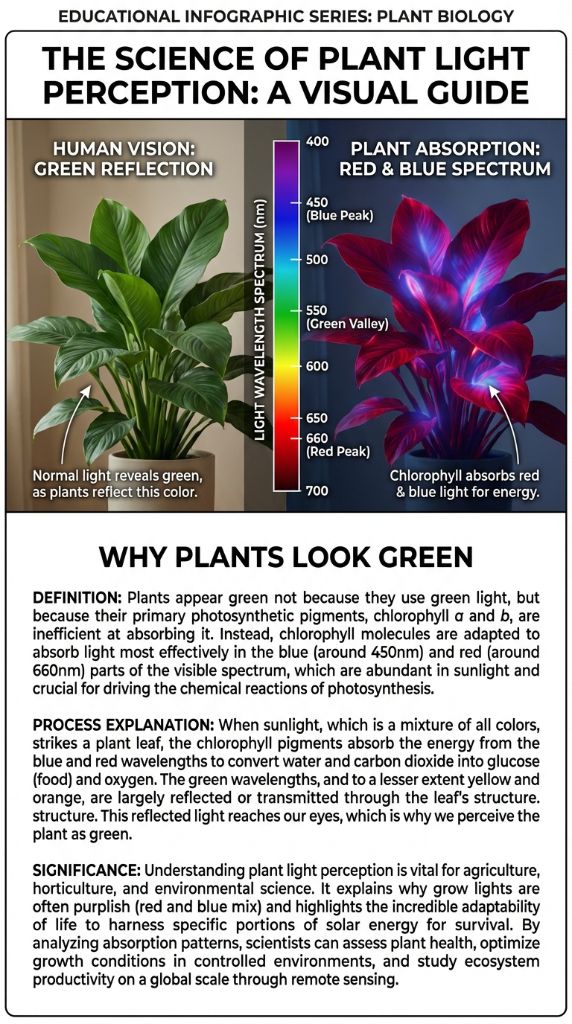
Blue Light Absorption Peak
Chlorophyll absorbs blue wavelengths most efficiently for vegetative growth and leaf development. Fulvic acid enhances the mineral cofactors that enable this absorption — particularly iron, magnesium, and manganese that are central to chlorophyll synthesis.
Red Light Absorption Peak
The primary photosynthetic energy wavelength. Red light absorption drives sugar production and fruiting. Nutritionally complete plants — with all mineral cofactors fully delivered — maximize their red light conversion efficiency, producing more carbohydrates per unit of light.
Where Deficiency Lives
When mineral cofactors are unavailable — locked in soil chemistry that fulvic acid hasn't unlocked — photosynthesis runs at a fraction of its potential. The light is there. The plant isn't absorbing it efficiently. That's what deficiency actually looks like at the molecular level.
How We Extract
Without Destroying
The extraction process is as important as the source material. Most producers use heat and chemical agents because they're faster and cheaper. We don't. Here's our process.
Source Selection
Leonardite ore selected for high humic substance concentration. Sourced from verified geological deposits with documented humate content. Not all leonardite is equal — source quality determines ceiling quality.
Cold Water Extraction
Water-based extraction at controlled low temperatures. No heat. No chemical solvents. The process that most producers skip because it takes longer — and the process that preserves every functional group that makes the end product biologically active.
Molecular Separation
Humic and fulvic acid fractions separated based on molecular weight. This is critical — combined humate products allow each compound to interfere with the other. Separated, each performs its specific biological function without compromise.
Concentration & Verification
Concentrated to target specifications. Active compound content verified. Packaged in sealed foil bags or bottles that protect the molecular structures from light, heat, and moisture degradation. What goes in the bag is what was verified.
The Literature
We Work From
Ponomareva & Ragim-Zade — Landmark study on fulvic acid mineral extraction from solid geological material. 49.7% extraction at 200 days; 82% at 400 days. Foundational Soviet-era soil chemistry research.
Bernstein et al. (2019) — Humic acid application on cannabis: documented canopy uniformity improvement and positive effects on plant height and chlorophyll content.
PMC Cannabis Study (2024) — Effect of organic biostimulants on cannabis productivity and soil health. Confirms multiple positive outcomes with humic and fulvic acid application across growth stages.
Impello Biosciences Research — Comprehensive analysis of humic and fulvic acid roles as biostimulants in agricultural soil management and nutrient bioavailability optimization.
PT Horticulture (EN-CA) — Non-living biostimulant research confirming fulvic acid's small molecular weight enables direct leaf penetration, auxin-like cellular effects, and superior foliar delivery mechanism.
ConsumerLab Market Analysis — 32,000% variance in documented fulvic acid content across commercial products. Primary evidence that extraction method, not source material, determines product quality.